Structure and function of the axoneme
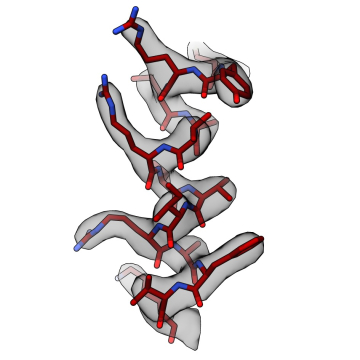
The axoneme is one of the most geometrically complex macromolecular machines in nature. We use cryo-EM to understand, in atomic detail, how it generates ciliary motility.
Read more
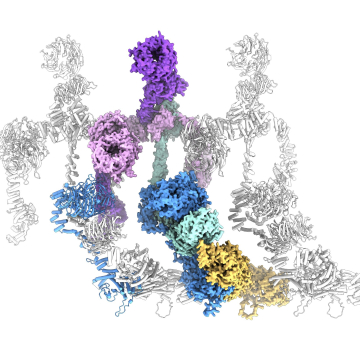
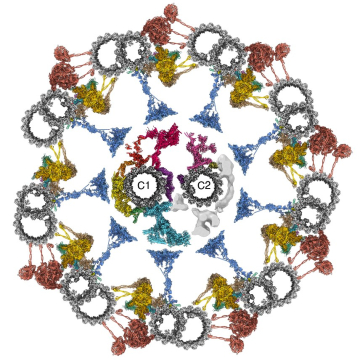
Motile axonemes have a “9+2” architecture: nine doublet microtubules (DMTs), each bound by dynein motors and regulatory complexes, encircle a central pair. Dyneins on one DMT pull against a neighbor to cause sliding and bending, with activity alternating across the axoneme to produce the waveform.
By biochemically deconstructing Chlamydomonas axonemes, we have resolved DMTs and their microtubule inner proteins, outer dynein arms, radial spokes and the central pair, often with Rui Zhang and Susan Dutcher (WashU). In 2023, we consolidated these into a near-complete atomic model of the axoneme repeat.
We are now studying mammalian and human axonemes from airway epithelia and other tissues to understand species-specific adaptations and the causes of motile ciliopathies.